
.png)

Beyond the agenda findings

Read the full report:
Beyond the agenda: Building capacity for governance
How governance and leadership are experienced in schools and colleges in England
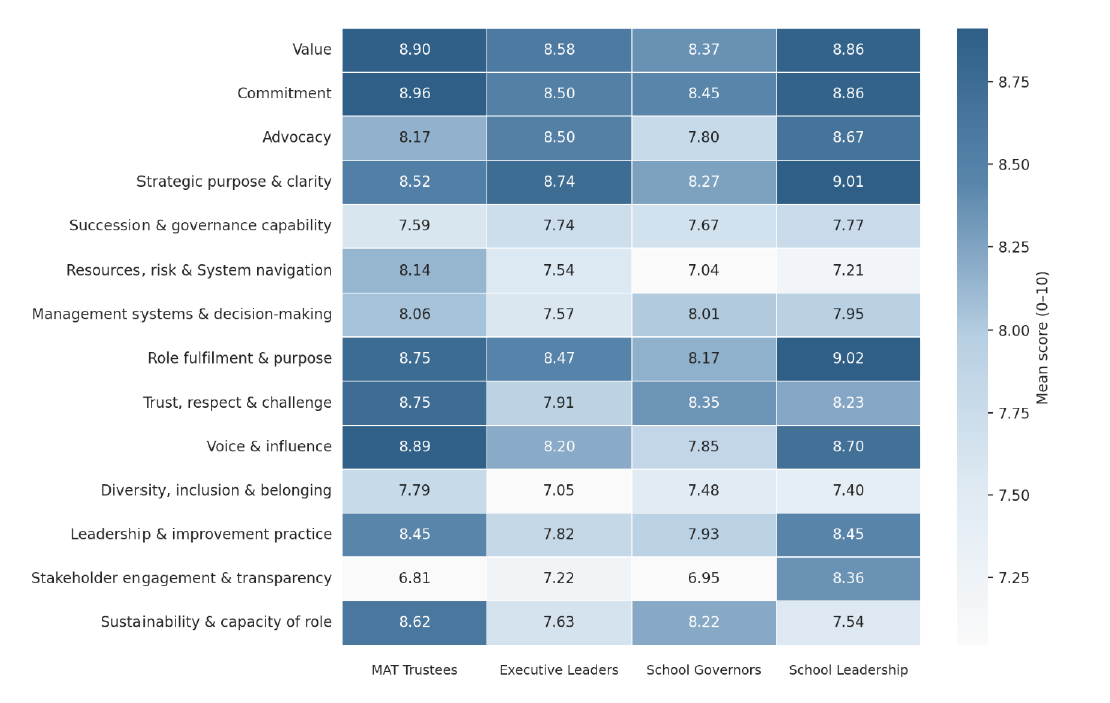
Over the past year, we have spent time listening to people who govern and lead schools and colleges, asking how governance is experienced from where they sit. To mark National School Governors’ Awareness Day, we are publishing findings from a new research project drawing on responses from more than 500 governance and leadership stakeholders across schools, multi-academy trusts and colleges in England. Together, they are responsible for around 40,000 learners.
The focus was simple. The research aimed to understand how engaged people felt in their roles, and whether there were differences in engagement and experience between people who work closely together. We wanted to understand how engaged people felt in their roles, and whether differences in engagement and experience between people who work closely together might offer an early signal that governance is becoming harder to sustain, before problems show up elsewhere.

Key findings

Confidence in funding drops the closer you get to delivery in schools
School Leadership score confidence in having the financial resources to deliver strategic goals at 4.44, compared with 6.44 for MAT Executive Leaders and 7.10 for MAT Trustees. School Governors sit in between at 5.26. The 2.66-point gap between Trustees and School Leadership is the largest divergence in the school dataset and follows a consistent gradient.

The same role is not experienced in the same way by everyone.
Demographic patterns show meaningful variation within governance and leadership roles. In schools, younger volunteer governance stakeholders report lower confidence on role sustainability and capacity than older peers. Gender differences cluster around perceived influence, with men reporting higher influence over strategy in both governance and leadership roles. In colleges, within-role variation is more targeted, but still visible, particularly around stakeholder engagement, learner voice, and future-facing capacity.

Governance believes challenge is working well...
.... leaders are less convinced.
In schools, MAT Trustees score their ability to ask challenging questions at 9.13, while Executive Leaders score the balance of support and challenge at 7.50. A similar gap appears at school level, and in colleges, although with higher overall scores.
The research provides education leaders with a benchmarking tool that offers actionable insights tailored to governance in trusts and school groups
What next?
Alongside the report, we are inviting schools, trusts and colleges to take part in the next phase of the research through The Engagement Platform. Participation is fully funded and allows organisations to see how their own patterns compare with emerging national benchmarks. Register here: Leadership & Governance
For CEOs and Board Chairs preparing for increased scrutiny, we also offer independent governance assurance reviews grounded in this evidence. These focus on traceability, line of sight and cumulative assurance, helping boards demonstrate how they know governance is working in practice. Contact us: hello@impactedgroup.uk
Latest reports
Latest research, campaigns and resources from the team at ImpactEd Group
.png)



Get in touch
To speak to one of our senior team about how we could support your work, please get in touch
