

Students who believe they can succeed make two months more progress in reading


New research reveals a connection between students' mindset and their academic achievement: secondary school pupils who believe they can influence their academic outcomes through effort make significantly greater progress in reading than their peers.
Professor John Jerrim of ImpactEd Group analysed data from 10,687 pupils aged 11-14 across 28 schools within Outwood Grange Academies Trust during the 2024/25 academic year. By combining data from The Engagement Platform (TEP) school engagement surveys with Key Stage 3 reading age assessments, the study uncovered the fascinating link between effort and progress.
Students with a higher sense of academic control achieved around two months additional reading progress compared to those who felt less in control of their outcomes, even after accounting for prior attainment and background factors.
The research also documented a notable decline in students' sense of academic control as they progress through Key Stage 3. Average scores on the perceived control scale fell from 7.54 in November 2024 to 7.07 in March 2025 and 6.98 in June 2025.
This decline was particularly pronounced among Year 7 pupils, whose scores dropped by 0.88 points between November and June. By spring term, approximately 20% of pupils reported lacking control over their school achievement, compared to just 13% in autumn.
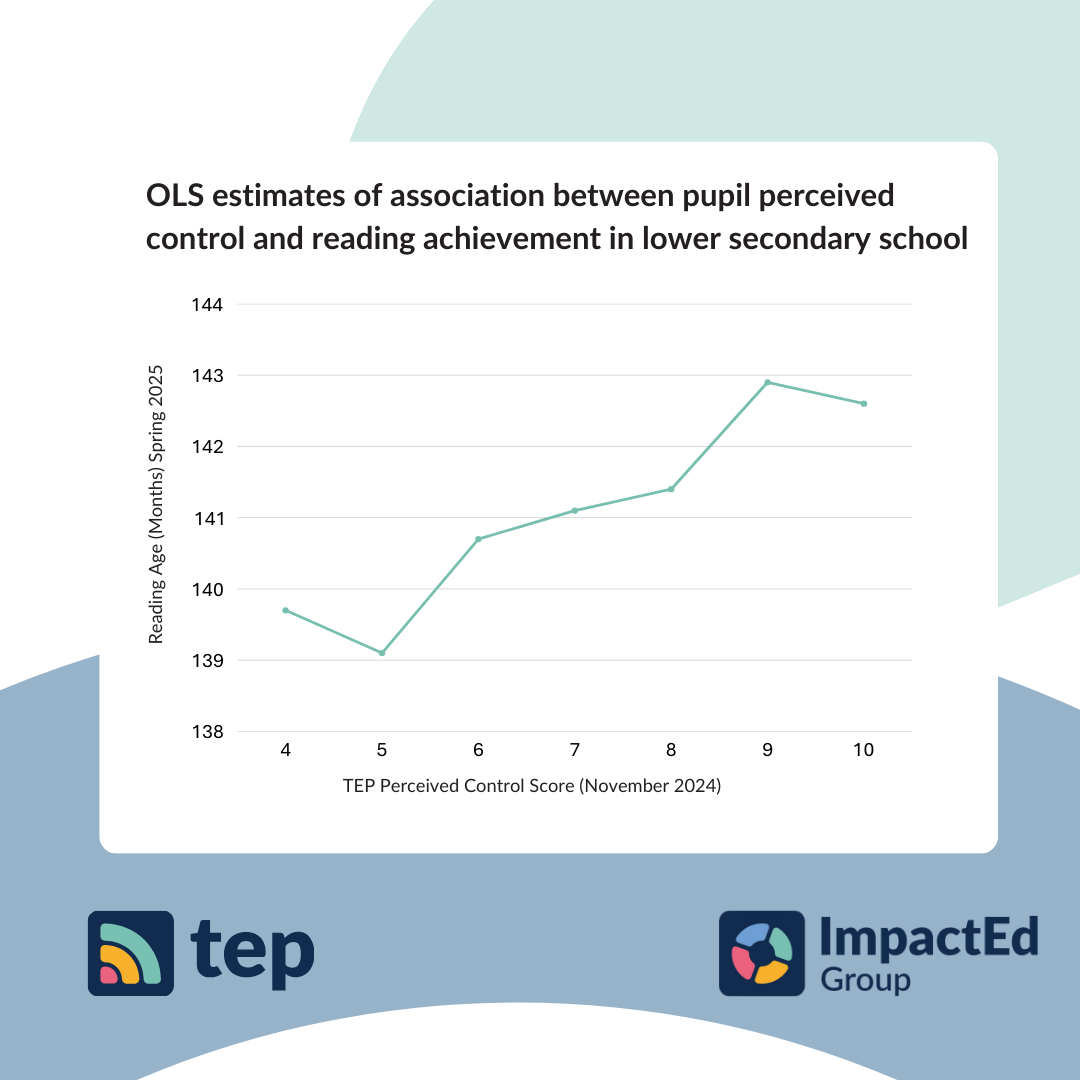
The Two-Month Advantage
Students who maintained high levels of perceived academic control (scores of 9-10) made approximately two months more progress in their reading age over a four-month period compared to those with low levels (scores of 6 and below). This held true even after controlling for prior achievement, demographics, school attended, and year group.
Who's Most at Risk?
While maintaining a strong sense of control was equally important across all demographic groups, the study identified clear differences in baseline levels:
- Socio-economically disadvantaged pupils (those eligible for Free School Meals) scored approximately 0.4 points lower than their more advantaged peers
- Pupils with special educational needs without an Education, Health and Care Plan reported the lowest sense of control
- English as an Additional Language pupils reported substantially higher perceived control scores than native English speakers
- White British pupils generally reported lower scores than other ethnic groups
An Early Warning System for Schools
Professor John Jerrim: "These findings add to a growing research base that is demonstrating the link between engagement and academic outcomes. There is much more to study, but this work is an important step forward and shows how this kind of data is becoming a valuable tool to support school improvement."
Lee Wilson, CEO of Outwood Grange Academies Trust, added: "This research allows us to further sharpen our approach to student support. By interlinking engagement and attainment datasets, we move beyond simply tracking results; it leaves us better equipped to identify the root causes of progress rather than responding to the symptoms of underperformance."
What This Means for Education
By equipping schools with engagement data as an early warning signal, educators can identify cohorts that need greater support before engagement and progress drops. The data shows that while the overall trend mirrors national patterns of declining engagement through Key Stage 3, some schools are able to stabilise or reverse this decline, highlighting the potential for targeted, school-level action.
Lee Wilson, "This 'early warning system' adds a sophisticated new layer to our existing practices. It enables us to intervene with even greater precision during critical windows like the Year 7 transition, ensuring we aren't just teaching young people to read, but actively protecting the belief in their own agency that makes that progress possible."
For schools interested in understanding engagement in their setting, TEP and ImpactEd Group has a variety of research options available.
Get in touch
To speak to one of our senior team about how we could support your work, please get in touch
